Drug Allergy Health Information ExchangeKorea Health Information Service · 2023-2025
For a drug allergy record confirmed at one hospital to be readable at another, you first have to decide what is exchanged and in what format. This pilot program, commissioned by the Korea Health Information Service, was carried out by the Seoul National University Hospital (SNUH) consortium, with Prof. Hye-Ryun Kang of the SNUH Division of Allergy and Clinical Immunology as overall lead. I took part as a co-investigator for Chungbuk National University Hospital. Phase 1 set the standard data elements for drug allergy information sharing, mapped them onto the HL7 FHIR AllergyIntolerance resource, and stood up a FHIR repository on the Health Information Exchange system so that information created at tertiary hospitals could be retrieved at primary care clinics. Phase 2 moved the sharing route to the Health Information Highway, so patients could check their own information in the My Health Record app and hand it to their clinicians, and the number of participating hospitals grew to 8. My part was writing the standard form and the value domains, and defining the items the existing FHIR standard did not cover, such as contraindicated, caution and safe-to-take drug groups, as extensions reflected in KR-Core and the Korean Core Data for Interoperability (KR-CDI).
30-second demo
My role
- In the phase 1 division of roles, Chungbuk National University Hospital was assigned 'allergy information generation' and 'KR-CDI and CORE linkage'. Of the three hospitals on the standard model development and standard information generation track, it was the one explicitly given the national standard linkage.
- In the second program's table of institutional roles, only Chungbuk National University Hospital is listed for 'defining the drug allergy data and interface standard.' The other seven hospitals are assigned HIS screen design, data entry, PHR linkage and testing.
- I designed the standard form and value domains for drug allergy information sharing around four areas: adverse events, reconciliation, document information and patient information. Culprit drugs follow ATC codes and symptoms follow MedDRA, and I adjusted the coding scope so that ingredients hard to express in ATC can also be defined with KD codes.
- I defined the elements missing from the HL7 FHIR AllergyIntolerance resource as extensions. The structure covers reaction type, severity, causality and whether confirmatory testing was done, and it expresses the contraindicated, caution and safe-to-take drug groups through the substance exposure risk extension as known-reaction-risk, potentially-crossreactive-reaction-risk and no-known-reaction-risk.
- I set the reconciliation rules that merge individual adverse events into one. Merge when the underlying mechanism is the same, keep them apart when it is not: hypersensitivity across NSAIDs becomes a single entry, while cephalosporin and quinolone antibiotics stay separate.
- I wrote the proposal to upgrade the allergy and intolerance elements of the Korean Core Data for Interoperability (KR-CDI). The current elements hold only onset date, causative substance and symptoms. The proposal adds safe-to-take drugs, contraindicated drugs, caution drugs, severity, causality and confirmatory testing, and asks that they be reflected in HL7 FHIR KR.
- We linked the adverse drug reaction management program in the Chungbuk National University Hospital HIS to the drug allergy sharing program, so that reported reaction histories register automatically as individual cases. In the second program, only the cases the Regional Pharmacovigilance Center and the research team judged shareable flow automatically into the PHR database.
- We won the Excellence Award in the back-referral category of the 2023 Health Information Exchange best-practice contest. The entry came from the Division of Allergy and Clinical Immunology and the Regional Pharmacovigilance Center at Chungbuk National University Hospital, and its subject was sharing drug allergy information through the Health Information Exchange system.
Outcomes at a glance
What we built
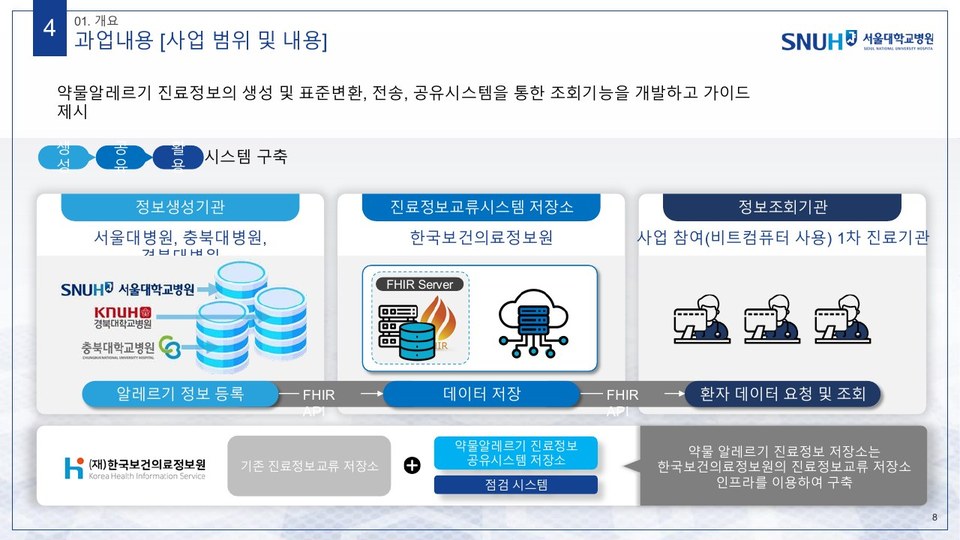
Program structure in three columns: generate, share, use
The generating hospitals (Seoul National University, Chungbuk National University and Kyungpook National University hospitals) push allergy records through a FHIR API into the Health Information Exchange repository at the Korea Health Information Service, and the primary care clinics taking part in the program read them back through the same API. We built no separate infrastructure: the drug allergy sharing repository and its checking system sit on top of the existing Health Information Exchange repository.
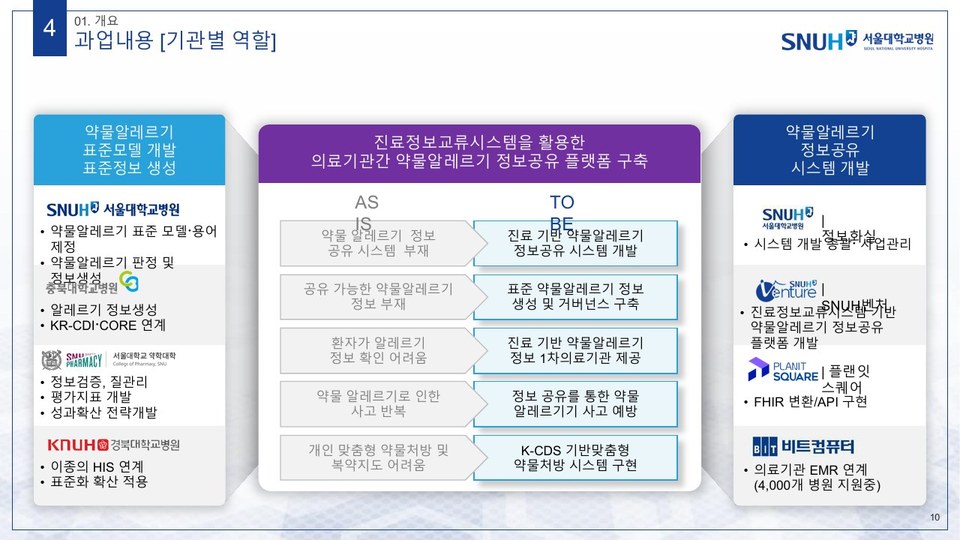
How the consortium split the work
Seoul National University, Chungbuk National University and Kyungpook National University hospitals and the Seoul National University College of Pharmacy developed the standard model and generated the standard records. The SNUH Office of Information, SNUH Venture, Planit Square and BIT Computer built the systems. Chungbuk National University Hospital's share was generating the allergy records and mapping them to KR-CDI and KR Core.
Standard data elements and value domains for drug allergy information sharing
The adverse event area holds onset date, culprit drug and drug code, symptoms and symptom codes, severity, causality and a case description. The reconciliation area holds current status, reaction type, severity, causality, whether confirmatory testing was done, the contraindicated, caution and safe-to-take ingredients or ingredient groups, and the specialist's opinion. Document information carries the institution and the assessor, patient information carries the registered patient, and together these four areas make up the form.
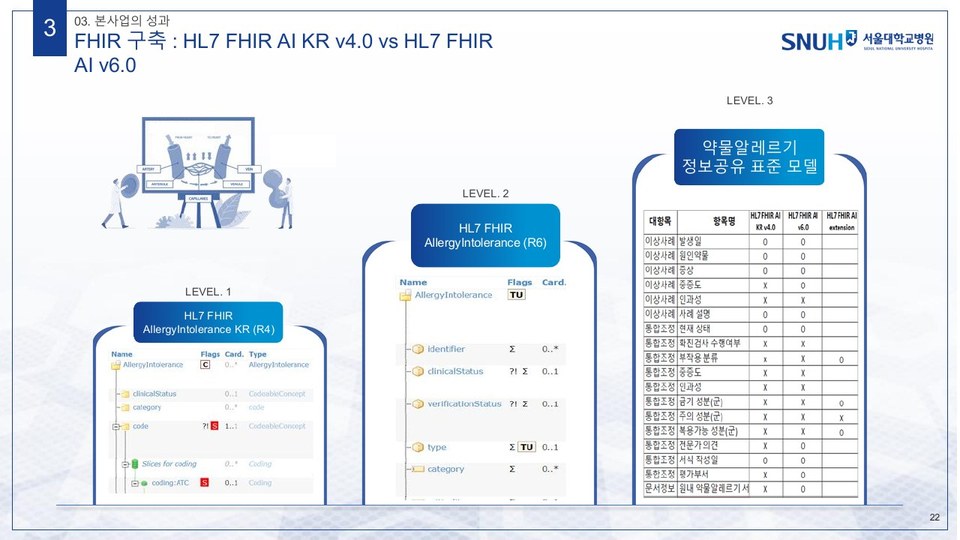
Extending HL7 FHIR AllergyIntolerance
I sorted the elements that existing standards cannot hold into three layers. Layer 1 is HL7 FHIR AllergyIntolerance KR (R4), layer 2 is AllergyIntolerance R6, and layer 3 is the drug allergy information sharing standard model, which defines the elements found in neither standard as extensions. Causality, whether confirmatory testing was done, the contraindicated, caution and safe-to-take ingredients or ingredient groups, and the specialist's opinion are the elements newly defined as extensions.
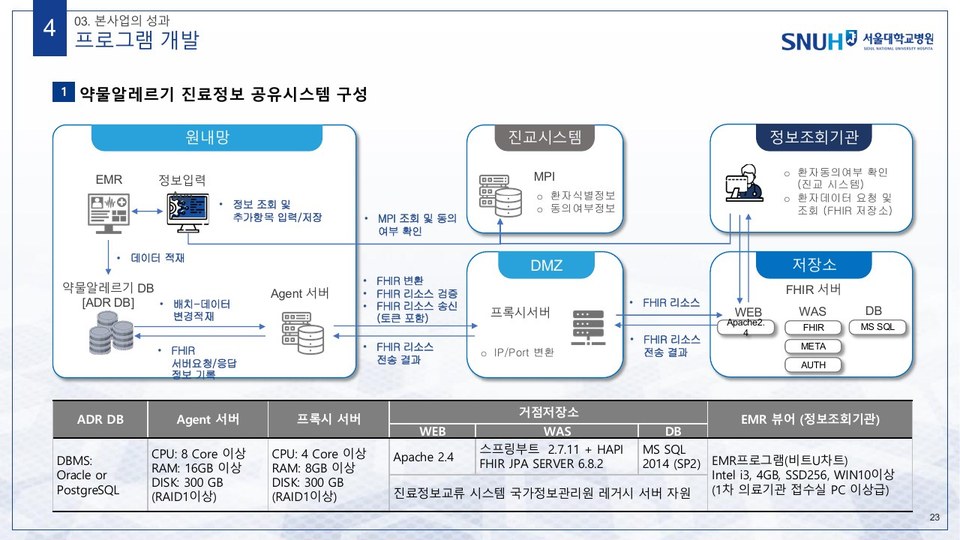
Building the drug allergy information sharing system
Inside the hospital network, the ADR database and an agent server handle FHIR conversion and resource validation, then send the data through a proxy server in the DMZ to the FHIR server at the regional repository. Patient identification and consent checks run on the MPI of the Health Information Exchange system, and the receiving institutions read the consenting patients' data in their EMR viewer. We ran integration tests on nine scenarios and passed all of them.
Standards-based data generation and quality control
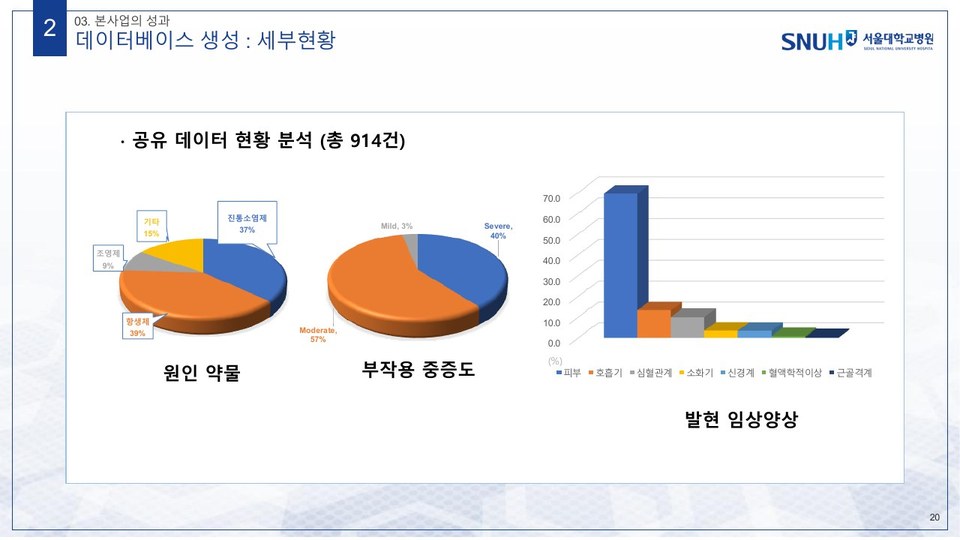
We did not use spontaneous reports as they came in. Allergists re-assessed every case rated probable or higher for causality and moderate or worse in severity, and picked what to share. Of the 914 cases collected in the first program, 39% involved antibiotics, 37% NSAIDs and 9% contrast media; 57% were moderate and 40% severe. Four advisory meetings, with allergists from primary care institutions and community pharmacists, reviewed the sharing screens and their contents.
Symposium and outreach
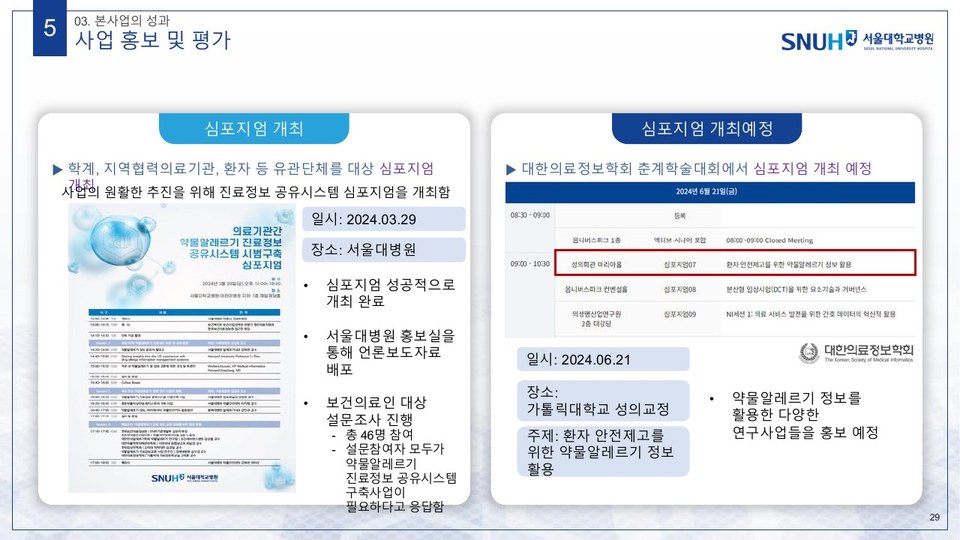
On March 29, 2024 we held a symposium at Seoul National University Hospital for academics, partner institutions in the region and patient groups. All 46 health professionals who attended said the system needed to be built. On June 21, 2024 we ran a session titled 'Using drug allergy information to improve patient safety' at the spring conference of the Korean Society of Medical Informatics, and we spread the word through the Korean Drug Allergy Research Consortium (KoDARC) newsletter and a patient leaflet.
The second program moves to the Health Information Highway
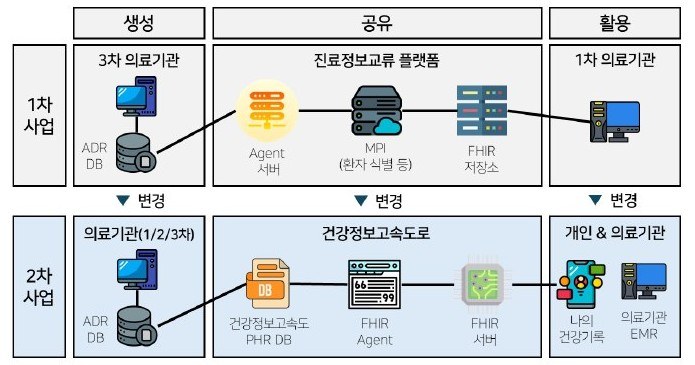
In the first program clinicians had to obtain consent from each patient themselves, and only the 10 clinics that had modified their EMR could look the records up. The second program switched the sharing route to the Health Information Highway: for patients who had already completed the consent process, records move from the hospital ADR database to the PHR database, and patients pull them up themselves in the My Health Record app and show them to their clinicians. Data generation also widened from tertiary hospitals to institutions at every level of care.
The second program's consortium and how it ran
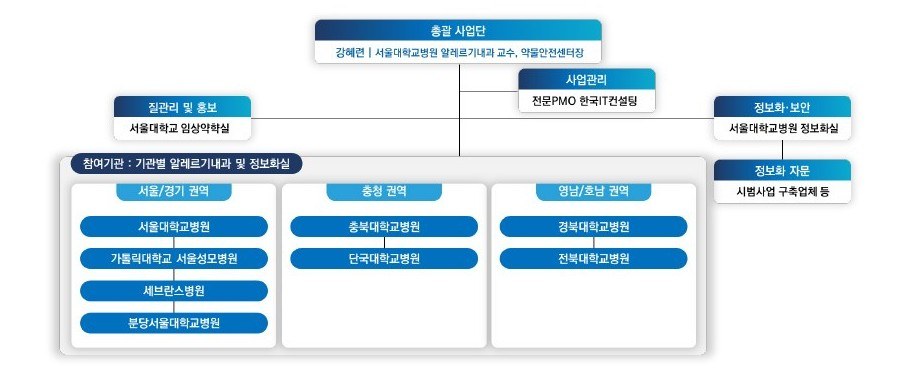
Eight hospitals took part: Seoul and Gyeonggi (Seoul National University Hospital, Seoul St. Mary's Hospital of the Catholic University of Korea, Severance Hospital, Seoul National University Bundang Hospital), Chungcheong (Chungbuk National University Hospital, Dankook University Hospital) and Yeongnam and Honam (Kyungpook National University Hospital, Jeonbuk National University Hospital). A data generation council and an informatics council ran separately and met fifteen times between August 2024 and March 2025 to align cases across institutions and settle a protocol for managing contrast media hypersensitivity.
Timeline
Results and dissemination
- Standard data elements and value domains for drug allergy information sharing (four areas: adverse events, reconciliation, document information, patient information)
- HL7 FHIR AllergyIntolerance profile and extension definitions (reaction type, severity, causality, whether confirmatory testing was done, and contraindicated, caution and safe-to-take drug groups)
- Standard terminology mapping rules (ATC and KD for the culprit drug, MedDRA for symptoms, SNOMED CT for reaction type, WHO-UMC for causality)
- A drug allergy FHIR repository built on the Health Information Exchange (HIE) system, with a monitoring console
- EMR data entry screens at three hospitals and an EMR lookup screen for primary care clinics
- 16 deliverables from phase 1 (requirements definition, functional specification, database design, FHIR profile definition, FHIR API specification, secure coding review report, unit and integration test plans and results, and more)
- 914 shared drug allergy records, validated by experts
- Table and interface specifications linking the Health Information Highway PHR database to hospital ADR databases
- A proposal to upgrade the allergy and intolerance elements of the Korean Core Data for Interoperability (KR-CDI)
- Program briefing materials, the KoDARC newsletter, a patient leaflet, and two symposia