Research
Five lines of research
A problem I meet in the clinic with a drug allergy patient becomes a standard for sharing information, then a tool in the patient's hand, then a question for pharmacovigilance and clinical research. The answer comes back as a feature of the hospital system.
Drug allergy information sharing and standardization Ongoing
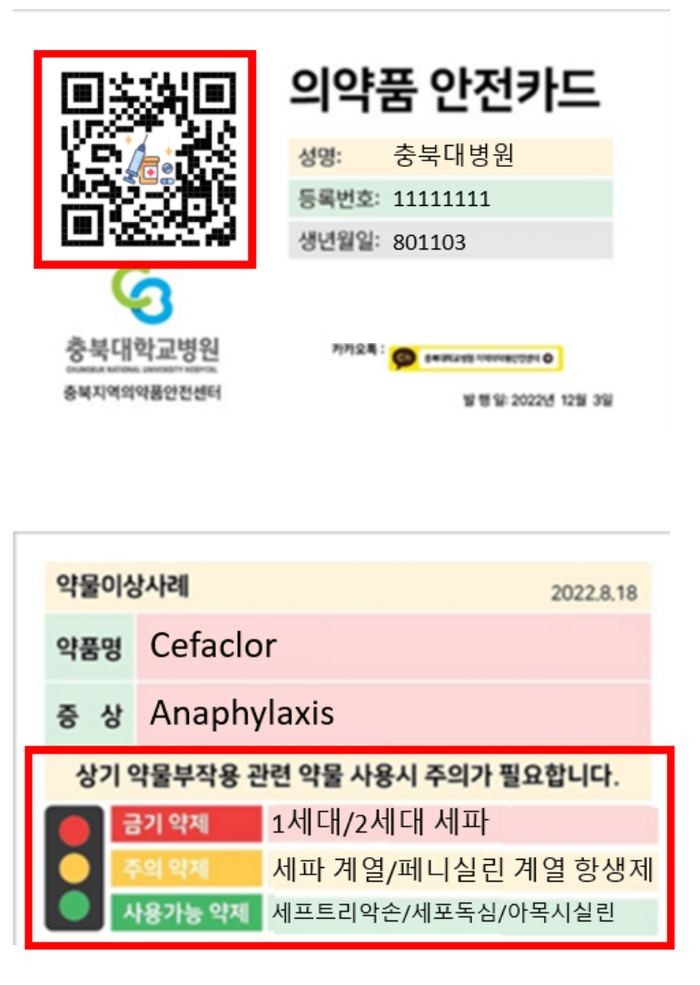
A drug allergy confirmed at one hospital is invisible at the next hospital or pharmacy. A patient who had anaphylaxis to cefaclor really does get the same class of antibiotic again at another institution. The HIRA DUR system does not carry an individual allergy history, and a paper drug safety card is hard for a patient to keep at hand at all times.
Standard form and HL7 FHIR AllergyIntolerance
The culprit drug, the symptoms, causality, and the contraindicated, caution and safe-to-take drug groups all fit on a single standard form (ver1.0, 2022), which we mapped to the FHIR AllergyIntolerance resource (KR Core, FHIR R4, 2024). We also built JSON and Excel conversion tools so implementers can work with the standard resource.
Health Information Exchange program, Korea Health Information Service
With the consortium led by Prof. Hye-Ryun Kang of Seoul National University Hospital, we built a pilot system that shares drug allergy records between hospitals (phase 1, 2023.10-2024.4; phase 2, migration to the Health Information Highway, 2024.8-2025.3). I set the standard data elements and value domains and refined the FHIR AllergyIntolerance profile. The work won an Excellence Award at the 2023 Health Information Exchange best-practice contest.
Digital Drug Safety Card and Allergy Passport
We issue the card in a standard form, and a single QR code opens it at any hospital or pharmacy (6 institutions). We also demonstrated an Allergy Passport that carries the same information into GPT and explains it in other languages. 2024 Society President's Award, Korean Society for Patient Safety.
Sharing that leads to MyData
Patients bring records they downloaded from the Health Information Highway (MyHealthWay) to the hospital, and we connected the Safe Medication CDSS so that it reasons from those records (MOHW R&D 2023-2025). I proposed drug allergy elements for the allergy and intolerance section of the Health Information Highway.
Patient-centered drug safety systems
This work puts a patient's own side-effect data in the patient's hands. Check it, show it, take it with confidence: I built those three steps as apps, cards, a platform, and a decision support system.
Drug Allergy Alert app
The app carries the contraindicated, caution and safe-to-take drugs confirmed in the allergy clinic, so a patient can search by drug name or scan the QR code on a prescription and get an answer tailored to them. 2018 Smart App Award Korea Grand Prize, Google Play 5.0.
My ADR platform and drug safety cards
We ran myadr.care, a platform that passes side-effect information between hospitals, at 9 university hospitals. Cards went out through the patient app and KakaoTalk alert messages.
MyData Safe Medication CDSS and Yagirang
A rule engine computes polypharmacy and drug allergy risk, and a multi-agent LLM writes the patient-facing safe medication guide. Field tested at 3 institutions.
Pharmacoepidemiology and active pharmacovigilance
This line of work turns hospital electronic medical records into a common data model to find drug safety signals, then measures their scale and risk factors with epidemiology.
CDM-based active pharmacovigilance
The Common Data Model (CDM) at Chungbuk National University Hospital began in 2015, when I joined a commissioned study of the Korea Institute of Drug Safety and Risk Management (KIDS) as the site lead. In 2017 I developed the analysis algorithms and a way to link a hospital EMR common data model with the Korea Adverse Event Reporting System (KAERS). Within that same line of work, the Korean multicenter active pharmacovigilance system (K-Sentinel/K-CDM), I took charge of moving hospital data into the standard structure. In 2019 I used the CDM to assess oseltamivir adverse reactions, and in 2020, as Principal Investigator, I ran the project that built a hospital electronic medical record common data model and set the backbone of our in-house CDM. Since then we have served as an analysis site in the KIDS MOA-CDM network (a hospital EHR based common data model, codebook 1.2 to 1.4), feeding our hospital data into multicenter pharmacovigilance analyses. Since 2021 I have led Chungbuk National University Hospital as a participating institution in the Medical Data-Driven Hospital program (MOHW) under the Seoul National University Hospital consortium, rebuilding the CDM on the OMOP standard and widening its domains.
Pharmacoepidemiology studies
Outside the CDM, I have kept measuring the scale and outcomes of adverse drug reactions in real-world data. We surveyed across multiple centers what share of emergency department visits adverse drug events account for and what they cost, and that work produced a series of papers, including a first-author paper in PLOS ONE. We also developed and validated a trigger tool that finds drug-related emergency visits automatically. For severe cutaneous adverse reactions we analyzed a nationwide multicenter registry together with individual case safety reports to map the phenotypes and direct costs of each culprit drug, and I took part in genetic risk factor studies: HLA-B*58:01 pre-screening for allopurinol, HLA-B*13:01 for carbamazepine, and HLA-DRB1*15:02 for iodinated contrast media. The work has since widened to angiotensin receptor blockers and drug-induced liver injury, to oseltamivir, and to spontaneous reporting data on adverse drug reactions in older adults.
Asthma and allergy clinical research
Clinical research that starts with the patients in my clinic. It runs in four branches: thesis research, epidemiology and biomarkers, patient care tools, and clinical trials.
Thesis research: gene expression in asthma and steroid hyporesponsiveness
My doctoral work read the pathophysiology of asthma out of gene expression in peripheral blood mononuclear cells. In the transcriptomes of patients during acute exacerbation I looked for shared gene modules and regulatory networks, and ex vivo dexamethasone experiments identified the molecular signature of poor steroid response. The same line runs on to a 2016 young investigator grant that approached the mechanism of steroid resistance in severe asthma through metabolomics, and to a 2022 Respiratory Research paper that split the immune phenotypes of asthma by peripheral blood transcriptomic clusters.
Asthma and allergy: epidemiology and biomarkers
I have also run asthma studies that tie epidemiology to the clinic: the epidemiology of adult asthma in Asia, how age of onset shapes the disease, phenotypes of asthma in older adults, the link between chronic rhinosinusitis, nasal polyps and asthma onset, biomarker work on the airway microbiome and the lung virome, and a multifaceted intervention to cut exacerbations in older patients with asthma.
Patient self-management apps and digital therapeutics
I have spent years building digital tools that let patients manage asthma and allergic disease themselves. It began with a 2013 abstract on a smartphone-based asthma action plan, and in 2016 I reported the feasibility of an app-based action plan and monitoring in Asia Pacific Allergy. In a 2020 planning study for the Korea Health Promotion Institute I designed a smart healthcare service model for chronic respiratory and allergic disease in primary care. From 2021 I served as Co-Principal Investigator on the Ministry of Trade, Industry and Energy program to build an AI technology support platform for the wellcare industry. In 2025 we rolled out SMART+ER, a counseling chatbot for patients with allergic rhinitis, across the hospital. We had first reported it in a European Respiratory Journal 2024 abstract.
Clinical trials
In the Division of Allergy and Clinical Immunology at Chungbuk National University Hospital I have been Principal Investigator on 12 clinical trials in asthma and allergic disease. They range from phase 2 and phase 3 trials of biologics and inhaled therapies for severe asthma to post-marketing surveillance and investigator-initiated phase 4 studies. Some of the results became a first-author paper in Scientific Reports 2025, a first-author paper in Nutrients 2020, and a co-authored paper in Lung 2025.
Medical informatics and clinical AI
As a physician certified in medical informatics (CPBMI), I build AI into hospital work and research. In 2025, as Director of the Medical Information Center, I connected an LLM to the hospital information system.
LLMs and multi-agent systems
A multi-agent system that writes a patient-specific guide from that patient's own side-effect data, clinical skills with a "no guessing" rule, and evaluation by an LLM judge. I compared commercial models with small open models on the same metrics.
Clinical automation tools
Tools I built because my clinic and my research needed them: medication counseling image generation wired together in n8n, a FHIR converter, allergy test result reports, OMOP CDM ETL, and a pre-visit intake system.
Medical foundation models
Since 2026 I have worked at CAMCA, in the Department of Radiology at Harvard Medical School and MGH, on foundation models, large language models, and diffusion models for medical imaging and clinical data.
Research at a glance
Now 2026.3 - 2027.2
I am a Visiting Researcher at CAMCA (Center for Advanced Medical Computing and Analysis, PI Kyungsang Kim), in the Department of Radiology at Harvard Medical School and Massachusetts General Hospital. The group works on foundation models, large language models, and diffusion models for medical imaging and clinical data. Here I am preparing my next studies, joining drug safety data to hospital AI.